
What is custom software?
Custom software is software developed for one specific company, tailored to its processes, data and users. It is also called bespoke software, tailor-made software, individual software or in-house development. The meaning is always the same: the software is not built for a broad market but for exactly one client.
Three characteristics define custom software:
- It follows your processes. The company does not adapt to the software, the software adapts to the company.
- It belongs to you. As a rule, you receive the rights to the source code and decide for yourself how it evolves.
- It grows with you. New requirements are implemented according to your priorities, not a vendor's roadmap.
Custom software does not have to be built "from scratch". Modern projects build on proven frameworks, cloud services and ready-made components for login, payments or documents. What is custom is what makes your business unique: the processes, the interface and the connection to your systems.
Custom software, off-the-shelf software, industry software: the terms
| Term | Built for | Example |
|---|---|---|
| Off-the-shelf software | A broad market, many companies use the same version | Accounting, CRM, office applications |
| Industry software | Many companies in one industry, with typical industry features | Software for trades businesses or property managers |
| Custom software | A single company and its processes | Customer portal, internal platform, dispatch tool |
Industry software is therefore a form of off-the-shelf software, just with a narrower target group. Which path is right in which situation is covered in detail in our decision guide Custom Software or Off-the-Shelf?
Examples of custom software
You come across custom software more often than the term suggests. Typical examples from mid-sized companies:
- Customer portal: Customers see their orders, documents and invoices, reorder or raise requests without calling.
- Internal platform: Employees work in one interface with one login instead of switching between many individual tools.
- App for field staff and construction sites: Orders, photos, checklists and times are captured on site and land in the system without retyping.
- Dispatch and planning: Routes, assignments, vehicles or materials are planned according to your own rules, which no off-the-shelf product knows.
- Connecting existing systems: A custom layer links ERP, accounting and online shop so that data is maintained only once.
- Digital product: A company offers its customers its own platform or app as part of its offering.
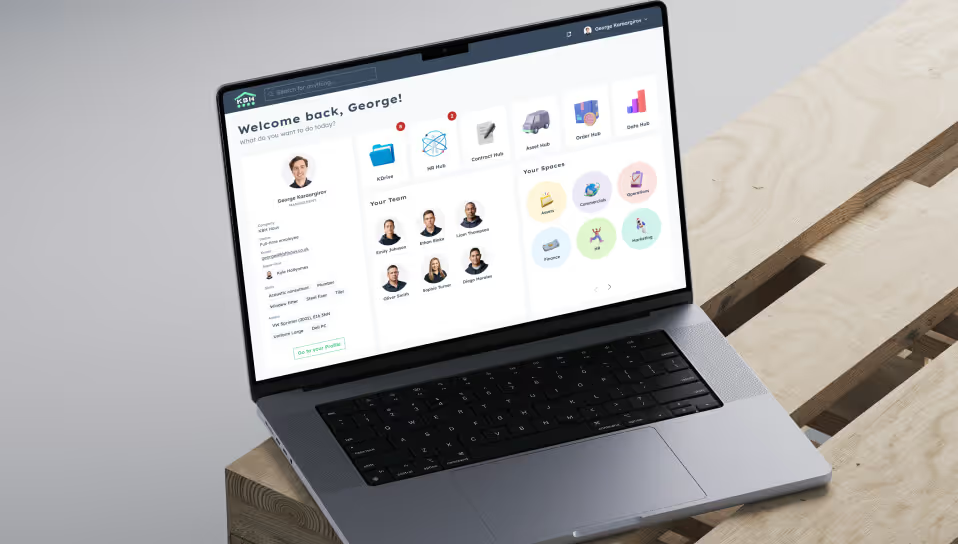
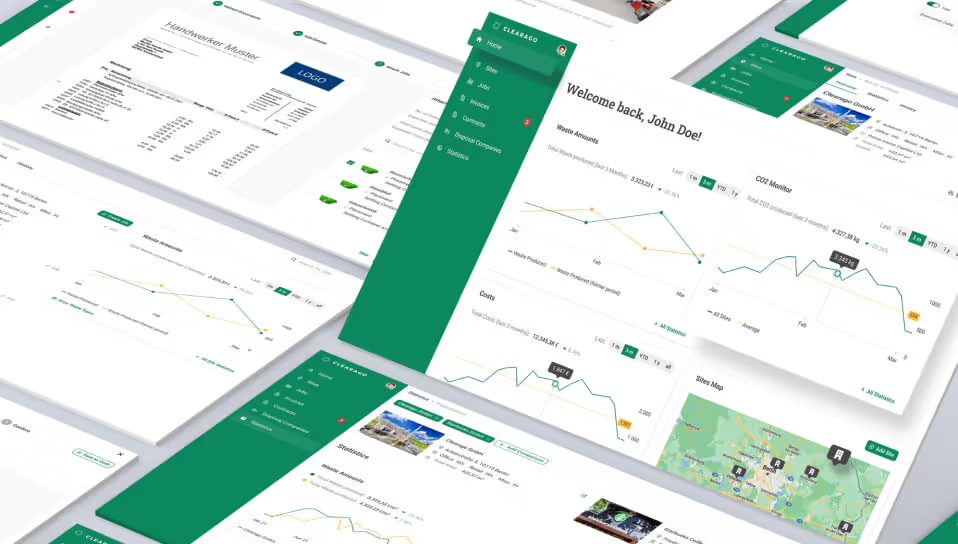
Two examples from our work: for KBH Haus we developed the KBH Hub, a modular platform for the construction industry that brings onboarding, projects, assets and documents together in one interface. For the container service Clearago we digitised paper-based waste management. You will find more industry examples in our articles on software for construction companies and software for waste management companies.
What custom software looks like today
In the past, custom software often meant a large program that was installed on individual computers and took years to build. Today it usually looks different:
- Web application instead of installation. The software runs in the browser, on a laptop as well as on tablets and smartphones. Updates reach everyone at the same time.
- Cloud operation. The software runs on servers in a data centre, in the EU if required. Backups, security and scaling are part of operations.
- Interfaces instead of isolated solutions. Through interfaces (APIs), the software works together with existing off-the-shelf software such as accounting or ERP.
- Step by step instead of all at once. First comes a real first version that runs with real data in everyday work. Then the software grows as needed.
Why custom software is affordable now: AI in development
For a long time the rule was: your own software is for large corporations. Every feature had to be programmed, tested and documented by hand, and that blew the budget of many mid-sized companies. Anyone with their own processes had to make do with a standard solution or live with spreadsheets.
AI has fundamentally changed this. Developers today work with AI tools that write code, generate tests, find bugs and create documentation. People remain responsible for architecture, quality and security, but a large share of the routine work disappears. That has three consequences for you:
- Less effort, lower costs. What used to be a big project is now a manageable one. Custom software is coming within reach of mid-sized budgets.
- A real result sooner. Instead of writing requirements for months, a first version your team can work with is ready quickly.
- Changes are cheap. Feedback from everyday use can be implemented swiftly. The software gets better step by step instead of being finished once and then rigid.
In short: the time is right. If you have been holding on to expensive standard solutions, a patchwork of tools or workarounds because your own software seemed too expensive, it is worth redoing the maths. More on this in Tool Patchwork or Expensive Off-the-Shelf Software?
AI inside custom software: put your data to work
AI doesn't just help with building, it now belongs in the software itself. The biggest lever is your data: customers, orders, products, contracts, documents. In many companies this data is scattered, duplicated or messy, and people spend a lot of time searching for it, typing it up and correcting it.
Connect your own database with AI and that changes:
- Read data on demand. Questions like "Which customers haven't ordered for six months?" or "Which orders are stuck right now?" are answered by the software in plain language, without anyone having to build a report.
- Edit data. AI reads emails, PDFs or photos and enters the content into the right fields in a structured way instead of someone typing it up.
- Clean data. Duplicates, inconsistent spellings, missing details and outdated entries are detected and suggested for correction.
- Enrich and classify data. Requests are sorted by topic and urgency, documents are automatically assigned to the right customer or project.
- Automate routines. Recurring steps, such as preparing quotes or asking follow-up questions, run in the background, and a person only approves.
The result is a huge efficiency gain: tasks your team used to spend a lot of time on in spreadsheets and inboxes get done in a fraction of the time. Your team takes care of customers and decisions instead of data maintenance. That lowers costs, speeds up processes and ultimately brings more revenue and margin into the business.
The advantage over an off-the-shelf AI tool: in your own software, AI works with your data, according to your rules and with clean access rights. No new island is created, and data protection can be built in from the start. How AI agents take over such processes is explained in AI Agents in Business.
Advantages of custom software
- Fits your processes. No workarounds, no spreadsheets next to the system, no features nobody needs.
- Competitive advantage. What sets you apart is reflected in the software instead of disappearing into a standard solution everyone uses.
- Control and independence. You decide on features, data storage and timing and are not dependent on a vendor's price increases or product decisions.
- No licence costs per user. When your team grows, costs do not automatically grow with it.
- Better acceptance. Software that works the way your team works is used more willingly. That saves training and rework.
- Clean data that works for you. When everyone works in one system, there is one source of truth instead of many copies. With AI, this data becomes a tool that takes work off your hands.
Disadvantages and how to manage them
Custom software has downsides too. Most of them can be managed well with the right approach:
| Disadvantage | How to deal with it |
|---|---|
| Higher upfront costs | Much lower than in the past thanks to AI-assisted development. On top of that, start with a first version that does only what matters most |
| Not available immediately | Quickly build a real first version with real data and test it in everyday work instead of planning for a long time |
| Maintenance is your responsibility | Agree on maintenance, security updates and operations with your partner from the start |
| Dependence on the development partner | Secure rights to the source code, access to the repository, documentation and widely used technologies |
| Risk of building past the need | Involve users early and deliver in small steps |
To work out what this costs over several years compared with off-the-shelf software, use the cost table in our decision guide.
Four misconceptions about custom software
- "That's only for large corporations." Not any more. Thanks to AI-assisted development, your own software is now realistic for mid-sized budgets too, and companies with their own processes benefit in particular.
- "Then we have to replace everything." Custom software usually complements existing systems. Accounting or ERP can stay where they work well.
- "We need to know everything in advance." A short conversation and a first version with your real data clarify more than a thick specification. Requirements are sharpened together during the project.
- "In the end we depend on the provider." Only if rights, code and documentation are not settled. With clean contracts, the software can be handed over to another team at any time.
How is custom software created today?
The classic path with a long specification, a clickable prototype and months of development until the first version is outdated. With AI, the route to a real product is more direct:
- Understand the problemIn a conversation we clarify which process costs time and money today, who uses the software and which systems and data already exist.
- Build a real first versionInstead of a clickable prototype, an AI-assisted working version connected to your real data is ready quickly.
- Test in everyday workYour team works with real cases. You immediately see what works and what is missing instead of guessing on the drawing board.
- Fine-tune with AIFeedback is implemented swiftly. Because changes take little effort with AI, the software becomes a precise fit in short rounds.
- Run and expandHosting, security updates and new features continue on an ongoing basis, according to your priorities.
For companies in Germany, the preparatory consulting, i.e. the analysis of which software your company really needs, can be subsidised by 50 to 80 percent through the BAFA programme "Funding of business consulting for SMEs". Our BAFA funding calculator shows how much you can get.
How uberneu supports you
We develop custom software for mid-sized companies: customer portals, internal platforms and apps that fit your processes exactly. We don't start with a specification document but with your problem. After a short conversation, we quickly build an AI-assisted real first version with your data that your team tests in everyday work. We then refine it with AI in short rounds until it fits exactly and keep developing it step by step.
Where it pays off, we connect your software and database with AI: reading, editing and cleaning data and automating routines, so your team spends less time on data maintenance and more time with customers. We advise independently of vendors and will also tell you when off-the-shelf software is the better choice. You receive the rights to the code, clean documentation and, if you wish, operations and further development from a single source. For companies in Germany, the preparatory consulting can be subsidised by up to 80 percent through BAFA. Tell us about your project and send us a no-obligation enquiry.